How to Shorten a Wedding Speech (Without Losing What Matters)
Your speech is too long. Here's a systematic way to cut it down without cutting out the parts that actually work.
Part of the How to Write a Wedding Speech guide: structure, length, opening lines, and delivery.
Most first drafts are two to three times longer than the finished speech should be. This is normal. It means you had things to say, stories worth telling, people worth thanking. The problem isn't that you wrote too much. The problem is that not all of it is earning its place.
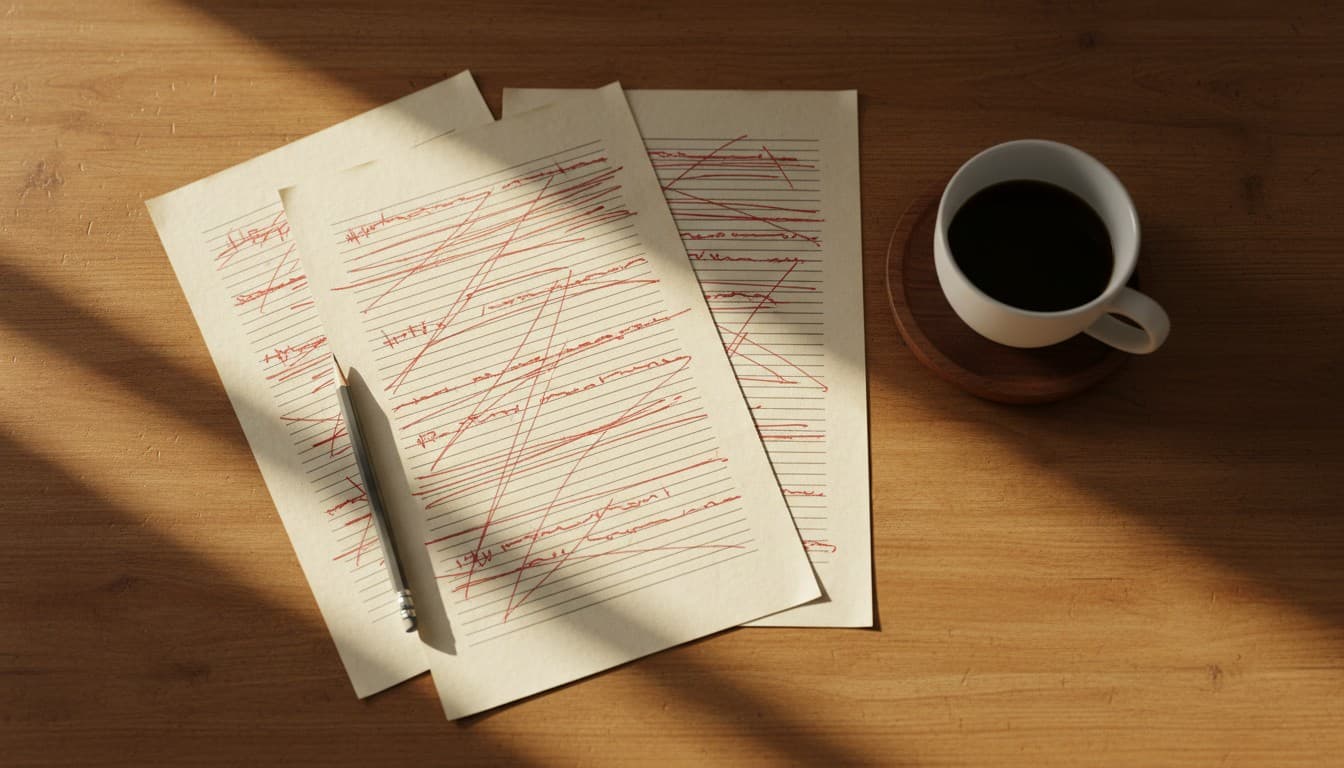
Now you have to cut.
How long should your speech actually be
Before you start cutting, you need a target. Here are the realistic ranges by role, in minutes and approximate word count at a natural speaking pace:
Best man: four to six minutes, roughly 600 to 900 words. Maid of honor: three to five minutes. Parents of the couple: three to four minutes. Friends giving a toast: one to two minutes, and that is genuinely enough.
If you are at six minutes and you're the best man, you are right at the limit. If you are at nine minutes, you have real work to do. If you are at twelve, you need to make peace with the fact that a substantial chunk of what you've written won't be in the speech.
Read it aloud and time it first
Before you cut a word, read the whole speech out loud and time it on your phone. Not in your head. Out loud, at roughly the pace you'll use in the room.
You need the real number, not the word count. Word count lies. A thousand words read at a measured pace with pauses for laughter runs about seven minutes. The same word count read at the pace most people actually speak at a wedding runs closer to five. You cannot know where you are until you hear it.
Once you have the number, you know how much time you need to cut. Then you can start.

Where the extra length is hiding
Most speeches that run long have the same problem in different places. Once you know where to look, the cuts become obvious.
The first place is the setup before each story. Read through your speech and find every place where you begin a story. Then look at the two or three sentences before the story actually starts. Usually they are doing setup work that the story doesn't need. "I first met Jake during our freshman year in the dorms. We were both studying late one night, and I remember thinking we'd probably never talk again. But then one night..." Most of that preamble can go. Start with Jake, in the specific moment.
The second place is the thank-you list. If you have a paragraph that thanks the venue, the caterer, the bridesmaids, the groomsmen, both sets of parents, and the couple's dog, that paragraph is probably 90 seconds of your speech. You can thank the people who matter in one sentence at the end: "I want to thank everyone who made this day happen, and I want to thank [name] for letting me be part of it." Done.
The third place is explanations. If you catch yourself explaining why something is funny, the joke didn't work. Cut the explanation. Often you should cut the joke too. A line that needs context to land is a line that isn't landing.
The fourth place is the second ending. Most speeches end twice. There's the real ending, the moment where the emotion crests, where you say what you came to say, and then there are one or two more sentences after it that exist because the writer wasn't sure the ending was enough. It is. Stop after the real ending. Anything past it is just trailing off.
The fifth place is the throat-clearing at the start. "I've been asked to say a few words about..." is usually the first sentence of a long speech. "When I first heard I'd be best man, I panicked a little..." is better, but still warmup. The best speeches just start: a line, a story, a moment that pulls the room in. Find where you actually begin and start there.
The test for whether a cut is right
After you take something out, read what remains. Does the speech still make sense? Does the emotional beat still land? If the answer to both is yes, the cut was right.
If removing a story leaves a gap, it means the surrounding material was depending on it. Either put the story back or cut the surrounding material too. You're looking for a speech where every part is load-bearing.
The other test is simpler: does it slow the room down? A long preamble before a story slows the room. An explanation of a joke slows the room. A list of ten names the audience doesn't recognize slows the room. Anything that makes the audience wait for the point is a candidate for the cut.
What you should not cut
The one story that only you could tell. Not a story that anyone who knew the groom could tell, but the specific thing you were there for, the detail that no one else has. That story is the reason you're speaking.
The moment that gets quiet. If you have something in your speech that, when you practice it, makes you pause for a second, that is probably worth keeping. Those are the moments the room will feel.
The toast line. The last sentence, where you raise the glass. If it's good, it should be there exactly as you wrote it. Don't cut it to save a few words.
Some specific cuts that always work
Here are phrases that appear in long speeches and can almost always go:
"I could go on and on..." You shouldn't, so don't reference it.
"I know [name] would want me to say..." This usually introduces something the speech could live without.
"And that's when I realized..." followed by a lesson. Most speeches don't need the lesson stated explicitly. If the story was told right, the lesson is already there.
"I've known [name] for X years, and in that time..." The number of years rarely matters. Start with what you observed.
"Last but not least..." Just end.
Before: "I've known Marcus for going on eleven years now, and in all that time I've always admired the way he approaches a problem. He has this incredible ability to stay calm when everyone else is panicking, and I saw that firsthand when..."
After: "The first time I saw Marcus actually rattled was..."
The second version is shorter and gets you to the moment faster. That's almost always the right direction.
Where to end up
The speech you're cutting toward is better than the speech you started with. Not because shorter is automatically better, but because every cut you make is a decision about what matters. By the time you're done, what remains is the stuff that earned its place.
Four minutes of the right things lands harder than eight minutes of everything you could think of. The room will feel the difference.
Keep reading:
- How Long Should a Wedding Speech Be?
- The 3-Minute Wedding Speech Template
- How to Practice Your Wedding Speech
If the issue isn't length but the speech itself, if you're cutting a draft that doesn't quite work yet, SpokenVow builds three complete drafts shaped around your specific stories, already timed to the right length. So you're editing something worth editing.