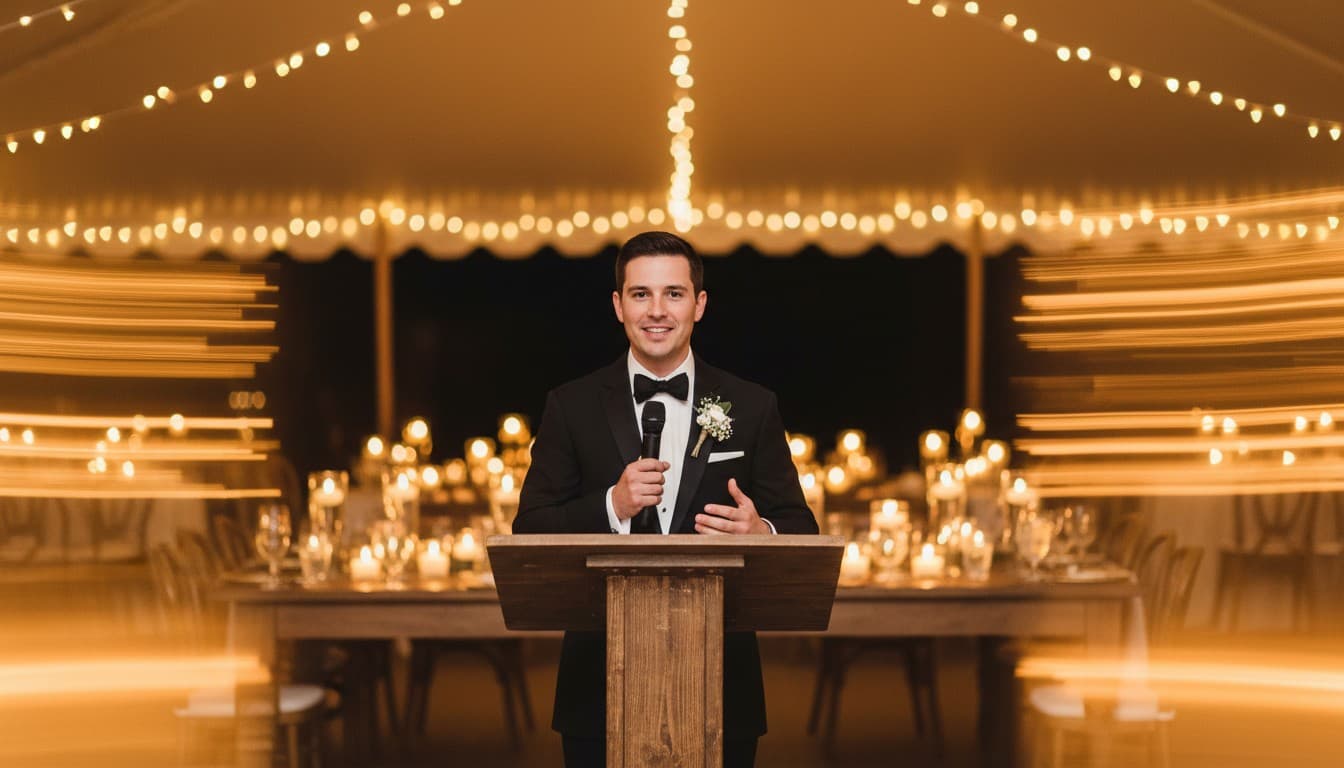
How to Practice Your Wedding Speech (So It Doesn't Sound Rehearsed)
The right way to rehearse a wedding speech: timing, delivery, nerves, and how to sound natural on the day.
Part of the How to Write a Wedding Speech guide: structure, length, opening lines, and delivery.
The worst version of a rehearsed speech sounds exactly like a rehearsed speech. The cadence is too even, the pauses land in the wrong places, and somewhere around the third paragraph the person giving it stops making eye contact and starts reciting.
The goal of practice is not to memorize the speech. The goal is to internalize it well enough that you can be present while you deliver it.
Those are very different things. Here's how to get to the second one.
How many times you actually need to rehearse
More than you think. Less than you're fearing.
The honest answer: seven to ten full read-throughs out loud, spread across multiple days, is enough for most people. Not seven back-to-back sessions in one evening. A few runs on different days, each one teaching you something slightly different.
Here's roughly how those sessions break down:
Days one and two (runs one and two): you're just getting familiar with the shape of it. Notice what feels natural and what feels forced. Notice where you stumble over a phrase, that's usually a sign the sentence is too complicated.
Days two through three (runs three through five): you're starting to find your pace. This is when you time yourself for the first time. You will probably be surprised.
Days four and five (runs six through eight): you know the speech now. This is when you practice the delivery: the emphasis, the pauses, the moments where you look up and actually mean what you're saying.
Day of, one final run: go through it once, calmly. Not to nail it. Just to settle in.
Record yourself
This is the practice tool most people skip because it's uncomfortable. Skip it and you'll miss the most important information available to you.
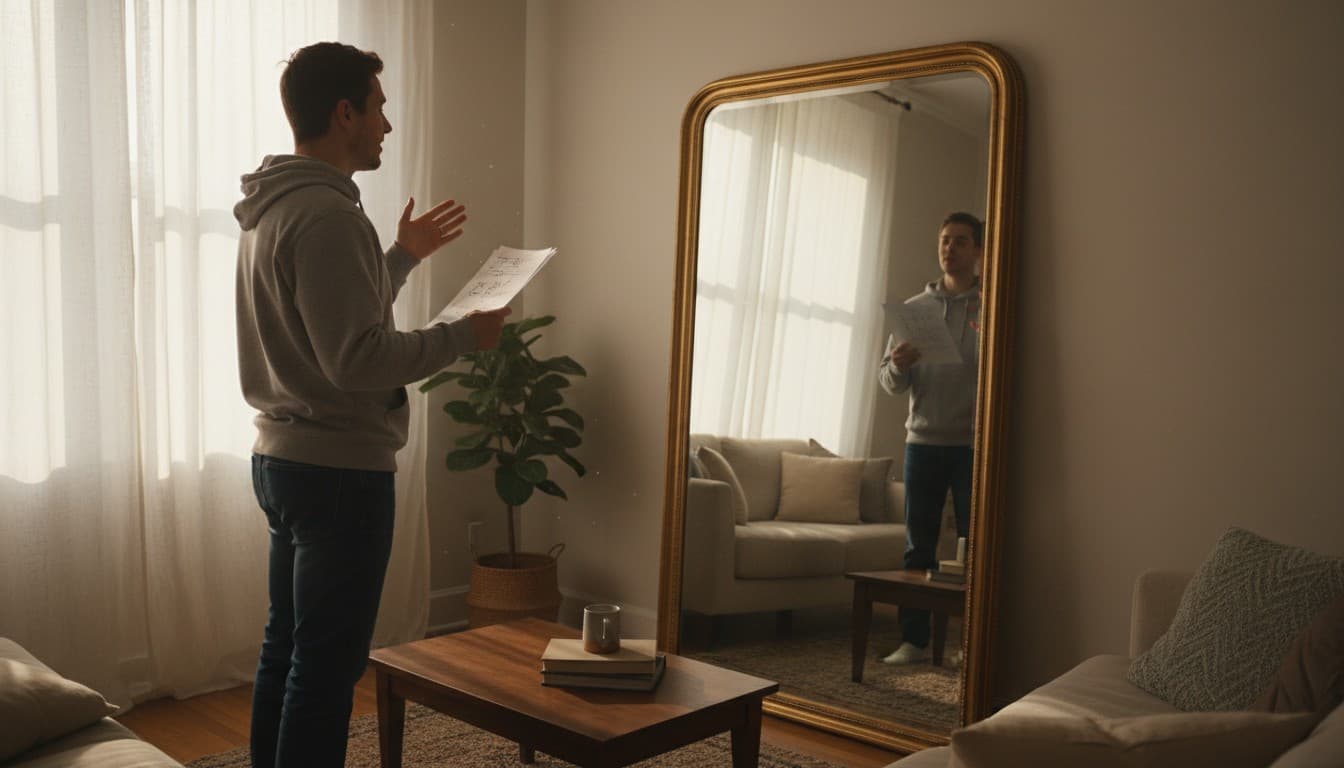
Record yourself on your phone. Full speech, out loud, as if you're delivering it. Then listen back.
You will hate it. Do it anyway.
What you'll hear: where you're rushing, where you're dragging, where a pause should live that currently doesn't, and whether you sound like yourself or like someone performing a speech. That last one is the most important.
If it sounds like a performance, you're probably holding the text too close. If it sounds like you talking to someone you know, you're there.
Video is even more useful than audio if you can handle it. Watch your hands. Watch whether you're looking at the room or at the page. The camera sees what the room will see.

The danger of memorizing word for word
Memorization is a trap. When you memorize verbatim, you build a fragile system where any small deviation, a word you can't quite retrieve, a laugh from the room that breaks your rhythm, a moment of genuine emotion that takes over, can knock you off track. Suddenly you're standing there unable to find the next sentence.
Know your beats instead. Know the shape of each section: what you're trying to say, what the story is, where it's going. The exact words can vary. The arc should be stable.
Think of it like directions versus GPS. GPS recalculates if you take a wrong turn. Memorized directions don't.
If you want a script in your hand, that's fine. But know it well enough that the paper is backup, not the primary source. You should be looking at the room, not the page.
Timing: the 3 to 4 minute sweet spot
For most wedding speeches, three to four minutes is the sweet spot. Four to five if you're the maid of honor or best man and have a lot of ground to cover. Five to six if you're a parent and the room expects it.
Time yourself out loud, not in your head. The internal voice reads at a very different pace than your actual speaking voice, and the gap is always larger than you expect.
A few timing realities to plan for:
Laughter takes time. If you have a moment that reliably gets a laugh in rehearsal, build in three to four seconds for the room to respond. If you plow through it, you cut off the reaction and lose the energy.
Emotion takes time too. If there's a moment where you're likely to feel it for real, plan for a pause. Not because you're going to fall apart, but because that pause is often the most powerful beat in the whole thing.
Nerves speed you up. Most people speak faster when nervous. If you're hitting exactly four minutes in rehearsal, you'll probably run slightly faster at the reception and land around three and a half. That's fine. Just don't bank on nerves slowing you down.
What to do with your hands
This is a small thing that takes up enormous mental space for a lot of people.
Hold your notes. That's the simplest answer. If you have your speech printed or on cards, holding them gives your hands something to do and removes the question entirely.
If you're not holding notes, the most natural default is one hand loosely at your side and the other holding your glass. Don't cross your arms. Don't put both hands in your pockets. Don't grip the microphone stand like you're keeping it from falling.
Here's the deeper truth: when you're genuinely connected to what you're saying, your hands take care of themselves. The hand anxiety usually means you're thinking about your hands instead of the words. Get into the words and the hands will follow.
Day-of nerves
Some nerves are unavoidable and some are useful. Adrenaline sharpens focus. The goal is not to eliminate the nerves but to not be ambushed by them.
A few things that actually help:
Do your final run-through somewhere quiet, alone. Not in a corner at the reception hall with people walking by. Not while getting ready. Find five minutes, go somewhere, and say it out loud one more time.
Don't look at your speech during cocktail hour. You know it. Reading it again will just make you anxious. Trust the rehearsal.
Find two or three friendly faces in the room before you stand up. When you're speaking, you can return to those faces. They become anchors. A room full of strangers becomes three people you know.
Before you start, pause for one breath. Not because you need the pause. Because it signals to your body that this is on purpose, not happening to you.
Keep reading:
- How to Memorize a Wedding Speech
- Terrified to Give a Wedding Speech? Read This First
- How to Not Cry During a Wedding Speech
The speech you've been building deserves a delivery that does it justice. Practice is just giving yourself the chance to be present for it.
Still working on the speech itself? SpokenVow builds drafts shaped around your specific stories and voice, already timed to the right length, so by the time you start rehearsing you're working with material worth the effort.