How to Give a Groomsman Speech (When You're Not the Best Man)
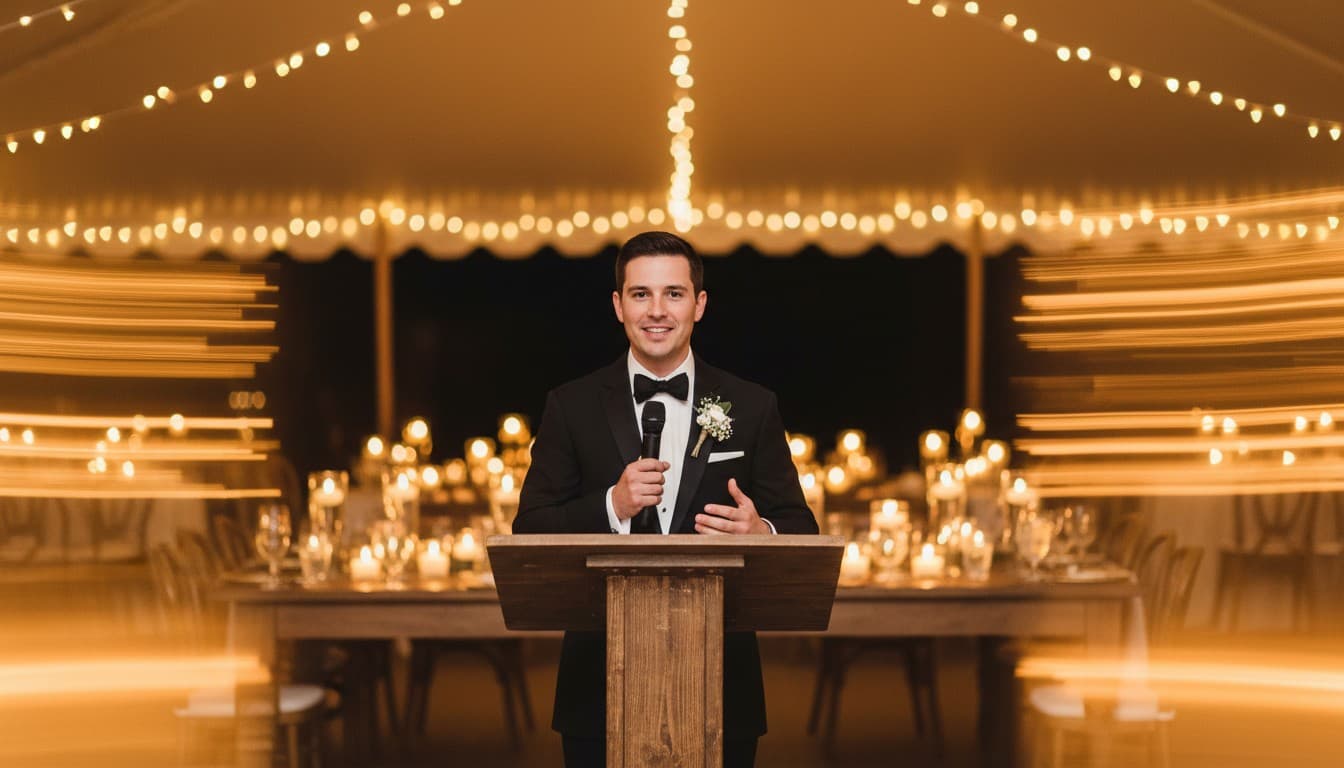
You're not the best man, but you've been asked to say something. Here's how to give a groomsman toast that holds its own, without stepping on anyone else's speech.
Related: Best Man Speech Guide : the complete resource for anyone holding a mic at the reception.
You're not the best man. The best man has a whole thing planned. You've been asked to say something, maybe sixty seconds, maybe three minutes, maybe the groom just said "you'll have some time" and left it at that.
This is a different situation. Not a lesser one, but different. Here's how to handle it.
Figure out your slot before you write a word
This is the step most people skip, and it's the one that changes everything.
Before you draft anything, ask two questions: how long do you have, and when are you going? Going first is different from going third. If you're third, the room has already laughed, already gotten a little emotional, already heard two stories about the groom. You need to know that going in.
Time matters even more. A 90-second toast and a four-minute speech are not the same piece of writing. One has room for a full story with context and a payoff. The other doesn't. If you treat a 90-second slot like a four-minute slot, you will go over, the DJ will give you a look, and you'll feel it.
So ask. Text the groom, text whoever is organizing the toasts. Get an actual number. Then plan around that number, not around what you think you can pull off.
The difference between a best man speech and a groomsman toast
The best man speech is the centerpiece. Everyone expects it to be substantial, structured, a bit of a production. The groom and the room are waiting for that one.
Your job is different. You're a supporting act. That's not a demotion. It's a different function. Supporting acts don't have to carry the whole show. They have to do one thing well.
The groomsman toast is usually shorter, more focused, and it works best when it does exactly one thing: lands one true observation about the groom or the couple, then closes cleanly. That's the whole goal.
The mistake is trying to match the best man's scope in half the time. You end up rushing through three stories and finishing none of them properly. One story, done right, beats three stories done badly.
What you have that the best man might not
Here is something worth thinking about. You know the groom from a specific angle. The best man probably knows him across the whole arc: school, early twenties, the whole progression. But you might have a different chapter.
Maybe you were his college roommate when the best man is a hometown friend. Maybe you've worked with him. Maybe you saw him at his worst right before things got better. That perspective, the one only you have from where you were standing, is the whole value of a groomsman toast.
One specific, true story from that chapter beats three generic ones every time. "He's the most loyal guy I know" is a claim. The story about the thing he did that made you sure of that is evidence. The room believes evidence. It nods along to claims and forgets them by the first dance.
Coordinate with the best man
This is the other thing people don't do, and it is absolutely worth doing.
Ask the best man what angle they're taking. Not the full script, just the direction. Are they going funny? Heartfelt? Heavy on stories from a specific era?
If they're going funny, you have room to go heartfelt. If they're going heartfelt, you can go short and punchy and give the room a breath. If they've already told the story you were planning to tell, you need to know that before you stand up, not during.
Coordinate is a big word for what is really just a ten-minute conversation. "Hey, what are you doing for yours?" That's it. You'll both be better for it.
What to avoid
Opening with "for those who don't know me." The room doesn't need your biography. One sentence on your relationship to the groom is enough, and even that can wait until after you've said something interesting.
Repeating what the best man just said. If the best man told the camping trip story, you can't tell the camping trip story. This is why you coordinate.
Going over your time. This is the groomsman toast sin nobody talks about. The room is generous, but it has a limit. When you said you'd take two minutes, take two minutes. Hit your toast line and sit down. The speeches everyone remembers as too long were the ones that had a natural ending and then kept going.
Trying to be funnier than you actually are. Humor in a toast comes from a real character observation delivered straight, not from attempting jokes. If you're not someone who naturally gets laughs in conversation, don't try to build a comedy bit into your toast. A sincere, specific story will land better.
Structure that works
For a two to three minute speech:
One sentence on who you are and how you know the groom. One story. One true thing about the couple, not a generic "they're perfect for each other," but something you've actually observed. A toast line.
That's it. That's the whole architecture.
For a 60 to 90 second toast, cut the story. You don't have time for it. Go straight to the observation and the toast. "I've known him for eight years, and the thing I know about him is X. [Couple's names], to both of you." That structure works. It does not feel thin if the observation is true and specific.
A complete example
This is a 250-word groomsman speech for someone who's known the groom through work.
Tom and I met on the worst day of a project I'd rather forget. We were both on a job that was running six weeks late, the client was not happy, and the team had been in the same conference room for what felt like a week straight.
And Tom, at about eleven at night, when everyone else was either panicking or shutting down, pulled out his notebook and said, "Okay, let's just figure out what's actually true." Not what we hoped was true. Not what would make the client feel better. What was actually true.
We fixed it. It took two more days, but we fixed it. And I thought: that's the person you want when things are hard. Not the one who manages how it looks. The one who wants to know what's real.
I met Rachel about a year later, and I watched Tom with her the same way I'd watched him in that conference room. He was present. He wasn't performing anything. He just wanted to know what she thought and what mattered to her.
I think she figured that out pretty early on. I'm glad she did.
Tom and Rachel, to both of you, and to knowing what's actually true.
The story earns the close. The observation in the middle ("not the one who manages how it looks") carries over to how he shows up in the relationship. The toast line connects back to the story. It's about 200 words, which at normal speaking pace is roughly two minutes.
The best speeches aren't the longest
The best man speech usually gets the most time. The groomsman toast gets less, which sounds like a constraint but is actually an advantage. Tight speeches can't hide weak material behind length. You have to find the one true thing and say it cleanly.
That one thing exists. You know something about this person that is specific and real and worth saying out loud in front of the people who love him. That's the speech.
Keep reading
- Best Man Speech Examples That Actually Sound Human
- Best Wedding Speech Opening Lines
- How Long Should a Wedding Speech Be?
If you know the story but aren't sure how to shape it into something that lands, SpokenVow runs an interview that draws out the right material and builds the structure around it. You bring what you know. The speech comes together from there.