How to Write a Wedding Officiant Speech (With Examples)
First time officiating a wedding? Here's exactly what to say, in what order, with real examples you can adapt. From the processional welcome to the pronouncement.
Related: Wedding Speech Examples : speeches and toasts for every role.
Your best friend called. Or your sister. Or the couple you've known for twelve years who somehow figured out that you are the exact right person for this.
You said yes because you love them, and because in the moment, standing there in their kitchen while they looked at you with that expression, saying anything else was inconceivable.
Now it's six weeks before the wedding and you're staring at a blank document, the cursor blinking, and you've realized that saying yes was the easy part.
Here's what you actually need to write.
First: you're not giving a toast
This matters. A wedding toast is a speech. It has a beginning, middle, and end. You tell some stories, you say something genuine about the couple, you raise your glasses.
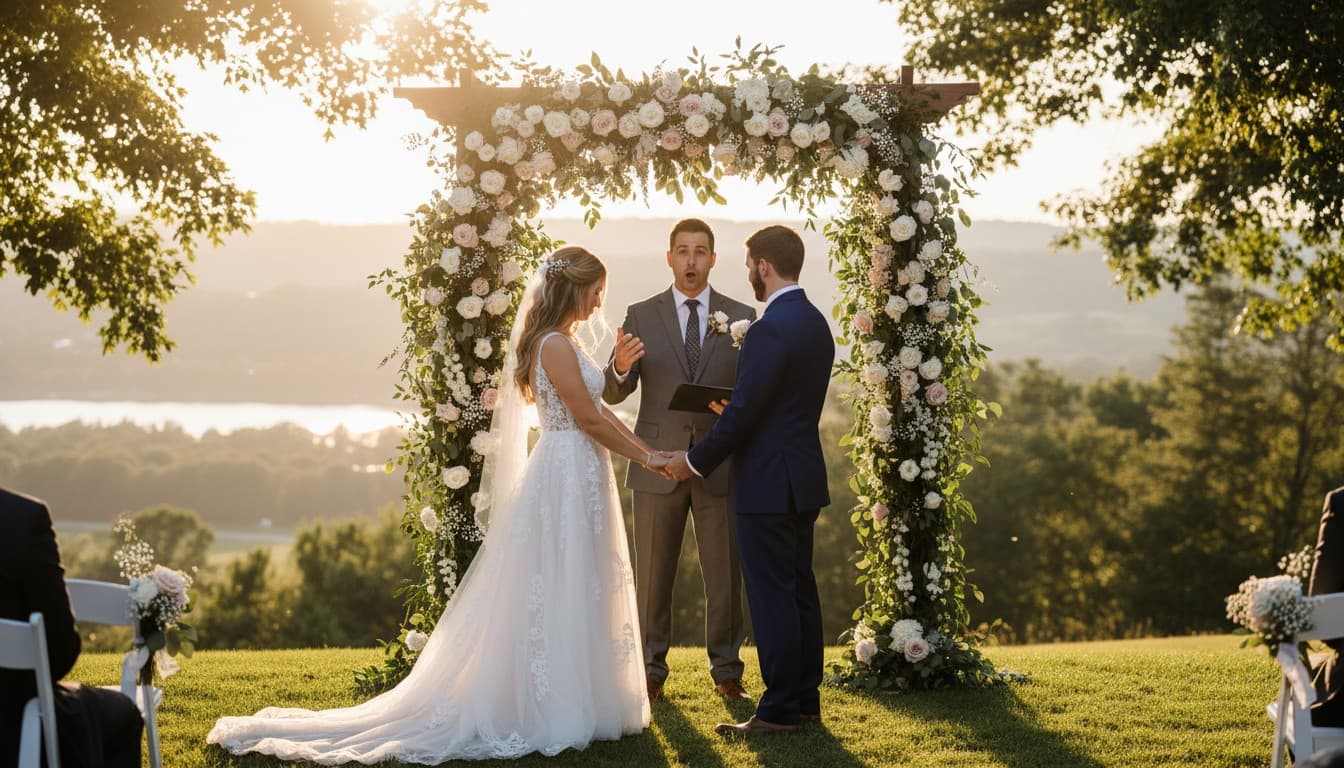
Officiating a ceremony is different. You're not giving a speech. You're running an event. You are the structure that holds everything together: the welcome, the words, the vows, the rings, the moment. People are not there primarily to hear you. They're there to witness the couple.
That's actually good news. The pressure is not on you to be brilliant. Your job is to be clear, warm, and largely invisible, present enough to hold the ceremony together, but unobtrusive enough that when people remember the day, they remember the couple, not you.
The structure of a ceremony script
Most wedding ceremonies, across venue types and levels of formality, follow the same rough shape. Here it is, section by section, with example language you can adapt.
1. The welcome
The processional music fades. People are settling. Everyone is looking at you.
This is your opening. It's brief. Its job is to call the room to attention and set the emotional register for what's about to happen.
Example:
"Welcome, everyone. Please find your seats. We gather here today, friends and family of [Name] and [Name], to witness something worth traveling for."
Or, warmer and more casual:
"We made it. Thank you all for being here. If you don't know me, I'm [Name], and I've had the privilege of knowing [Name] and [Name] for [X] years. I'm honored that they asked me to stand here with them today."
Keep it under sixty seconds. The room is ready. Get moving.
2. Who you are (briefly)
This is not the time for a toast about yourself. Two to three sentences. Who you are, how you know them, why it means something to be here.
Example:
"I've known [Name] since we were both fumbling through our first jobs in a city neither of us knew. I met [Name] the year everything changed. Watching them find each other has been one of the better things I've gotten to witness in my adult life."
That's enough. The room doesn't need your biography. They need to know you belong here. Three sentences does it.
3. Words about marriage (the heart section)
This is where most first-time officiants either over-write or reach for something generic. The dictionary definition of love. A Pablo Neruda poem they found on a wedding website. A three-minute meditation on commitment that sounds like it was written for a different couple entirely.
Skip all of that. Write something true about this specific couple. What have you observed about them? What does their relationship look like from the outside? That is more interesting and more meaningful than anything universal you could borrow.
Short and real beats long and borrowed. Always.
Example (for a warm, casual outdoor wedding):
"I've thought a lot about what I wanted to say about marriage, and I keep coming back to what I've watched [Name] and [Name] actually do over the last four years. They've moved apartments twice, navigated both their families during the holidays, supported each other through genuinely hard things, and somehow made every version of their ordinary life look like somewhere you'd want to be. That's not luck. That's a choice they make, every day, and it's why we're all here."
Example (for a more formal ceremony):
"Marriage is one of the oldest commitments humans make to each other, and also one of the most specific. It is not a promise made to an idea. It is a promise made to a particular person, with all their particularities. [Name] and [Name] know each other's particularities well, which makes what they're about to promise each other more meaningful, not less."
Aim for two to three paragraphs. This section should feel like it was written for them specifically, because it should be.
4. Readings (if any)
Some couples want a reading: a poem, a passage from a book, something from their tradition. If so, your job is to introduce it cleanly and then get out of the way.
Example introduction:
"[Name] and [Name] have asked [Reader's Name] to share a reading. [Reader's Name] is [brief relationship to couple], and this reading comes from [source, if relevant]."
Then step back. Let the reader read. When they finish, a simple "thank you" and a moment of silence before you move on is enough.
Don't editorialize the reading. Don't summarize it after. Let it land.
5. The vows
This is the moment. Everything else is setup for this.
If the couple has written their own vows, your job is to introduce them and then cue each person when it's time to speak.
Example intro for personal vows:
"[Name] and [Name] have written their own vows. [Name], whenever you're ready."
Then be quiet. Let them say what they wrote. Do not interject, summarize, or react visibly. Your job here is to hold the space, not fill it.
If the couple is repeating vows after you (the traditional call-and-response format), speak slowly and in short phrases. Not one giant sentence they have to hold in their head. Short clauses, pause, wait for them to repeat, move to the next.
Example (traditional repeat-after-me):
"[Name], repeat after me."
"I, [Name]..." (pause) "...take you, [Name]..." (pause) "...to be my partner in life..." (pause) "...to have and to hold from this day forward..." (pause) "...in joy and in difficulty..." (pause) "...for as long as we both shall live."
Go slow. They are nervous. The room wants to hear every word.
6. The ring exchange
Rings are a symbolic moment that moves surprisingly fast if you let it. Don't let it.
Example:
"The rings, please."
(Ring bearer comes forward, or someone hands you the rings.)
"These rings are a circle, which is a shape with no beginning and no end. They're also made of [gold/silver/whatever], which is a material that lasts. [Name] and [Name] have chosen to mark this commitment with something you can see and feel every day."
"[Name], place the ring on [Name]'s finger and repeat after me: With this ring, I thee wed."
Then the same in reverse.
Keep it moving but don't rush. This is visual and tactile and the photographers need a moment too.
7. The pronouncement
Here it is. The actual moment.
Example:
"[Name] and [Name], you have made your promises to each other in front of the people who love you most. By the power vested in me by the state of [State], it is my honor to pronounce you married."
Then: "You may kiss."
Or if the couple prefers something with a bit more warmth:
"I've been waiting a long time to say this. It is my great honor to pronounce you married. [Name], you may kiss your [partner/wife/husband]."
8. The introduction and exit
The kiss lands. The room erupts. Now you introduce them.
Example:
"Ladies and gentlemen, for the first time as a married couple, please welcome [Full Name] and [Full Name]."
Then step aside. Smile. Let them walk.
Tone: match their wedding, not your default
A ceremony on a hilltop in flip-flops is different from a ceremony in a church that's been in the family for four generations. The words you use should reflect where you are and who they are.
Casual outdoor wedding: contractions are fine, light humor is welcome, warmth over formality, a story or two, shorter readings or none.
Traditional or religious ceremony: more measured pacing, less personal anecdote, more reverence, quotes or readings that fit the tradition they're honoring.
If in doubt, ask the couple. Ask them: "What's the feeling you want people to have walking out?" and write toward that feeling.
The common mistakes
Reading too fast. Nerves accelerate speech. Write "SLOW DOWN" at the top of every page of your script. The room needs time to absorb what's happening. You are not presenting information. You are holding a moment.
Making it too long. A complete ceremony, including processional, vows, rings, readings, and recessional, should run fifteen to twenty minutes. If you're writing much beyond that, you're taking time that belongs to the couple. Cut the section that is doing the least work.
Making it about you. More than three sentences about yourself and your relationship to the couple starts to feel like a toast that wandered into the wrong event. Brief, genuine, then step aside.
Winging the legal parts. Know your lines for the pronouncement. This is not the place to improvise. Whatever your state requires you to say, say it exactly.
The legal basics
Laws vary by state, so confirm the specifics for where the ceremony is happening. In general:
You need to be ordained. Online ordination through the Universal Life Church or similar is legal in most U.S. states and takes about two minutes. Confirm your state recognizes it.
The couple needs a marriage license, obtained from their local county clerk before the ceremony. You sign it after. There are usually witness signature requirements.
The signed license needs to be returned within a certain window, typically within a few days. Know who is responsible for mailing it.
Get these logistics sorted a few weeks out. The paperwork is not romantic but it is required, and discovering a problem after the fact is a very bad gift to give a couple on their honeymoon.
The thing that grounds you
You are nervous. That's fine. Here's what helps: you are not the star.
The couple is the star. The vows are the star. Your job is to be so steady and clear and prepared that everyone can stop thinking about you entirely and focus on what's actually happening. That is not a diminishment. That is the whole job.
You were asked because they trust you. They didn't ask a stranger. They asked you, specifically, because of what you know about them and who you are to them. That trust is already there.
Write something true about this specific couple. Prepare enough that you're not performing, just present. Speak slowly. Get out of the way of the moment.
The rest is logistics.
Keep reading:
- Wedding Speech Examples
- How to Practice Your Wedding Speech
- 50 Wedding Speech Opening Lines That Actually Work
If the couple needs help writing their own personal vows, or someone in the wedding party is working on a reception speech, SpokenVow can help. We interview you the way a professional speechwriter would and build drafts shaped around your specific voice and stories.