Jewish Wedding Blessings and Toasts: What to Say and When
From the Sheva Brachot to the reception toast, here is what to include in a Jewish wedding speech, which blessings fit where, and how to honor tradition without losing the room.
See also: Wedding Toast Guide and Best Man Speech Guide
If you have been asked to give a speech or toast at a Jewish wedding, you are working inside a tradition that has been shaping weddings for thousands of years. The blessings, the Hebrew phrases, the structure of the ceremony itself: these are not decorative. They carry weight. And if you understand even a little bit about where they come from, your speech will be better for it.
This is a practical guide to what Jewish wedding blessings actually are, how to weave them into a toast or speech, and how to avoid the mistakes that well-meaning speakers tend to make.
What makes a Jewish wedding speech different
A Jewish wedding is structured around liturgy. The ceremony is not freeform. It follows a specific order: the betrothal blessings (Birkat Erusin), the reading of the ketubah (marriage contract), the Sheva Brachot (seven blessings), the breaking of the glass. Every element means something, and most of the guests know what it means.
This changes the job of the speechmaker. At a secular reception, you are often the only one giving the event its emotional shape. At a Jewish wedding, the ceremony has already done much of that work. Your speech at the reception is a continuation, not an introduction. You can reference what happened under the chuppah. You can echo the language of the blessings. You can draw on images and ideas that the ceremony already planted in the room.
The flip side: you cannot ignore the tradition either. If your speech treats the wedding as entirely secular, it will feel disconnected from what everyone just experienced. You do not need to be a rabbi to give a Jewish wedding toast, but you should know enough to speak to the room as it is, not as you imagine it.
The Sheva Brachot and how to reference them in a speech
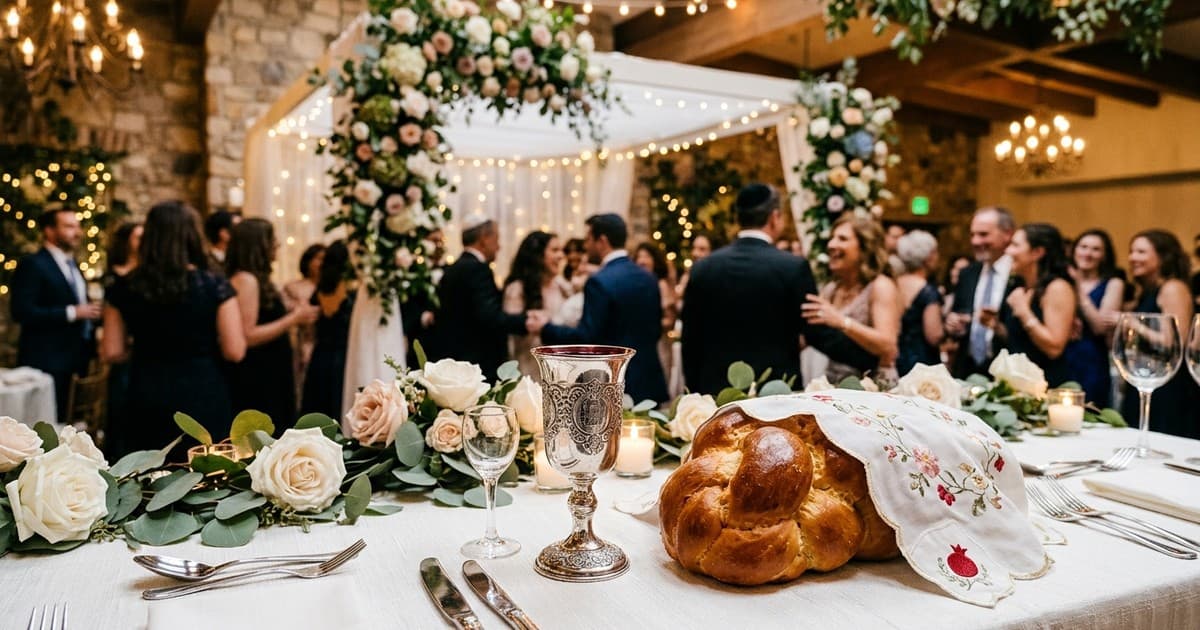
The Sheva Brachot, or seven blessings, are the center of the Jewish wedding ceremony. They are recited under the chuppah, traditionally over a cup of wine. In many communities, different honored guests are called up to chant each blessing.
Here is what they cover, in order:
The first blessing is over the wine itself. Borei pri hagafen, blessed is the creator of the fruit of the vine. Wine appears at almost every Jewish milestone. It opens the ceremony and grounds it in something physical.
The second blessing praises creation in general. The world itself, the fact that it exists, is the starting point.
The third blessing is about the creation of human beings. Not the couple specifically, but humanity. The scope is deliberately wide before it narrows.
The fourth blessing speaks of humans being made in the divine image, with the capacity to perpetuate life. This is where the blessings start turning toward the couple.
The fifth blessing asks that the "barren one" (a reference to Jerusalem/Zion) rejoice as her children return to her. This is the most overtly communal of the seven. It connects the private joy of a wedding to the collective hope of a people.
The sixth blessing asks God to make the couple as happy as Adam and Eve were in the Garden of Eden. The image is of uncomplicated, original joy, before anything went wrong.
The seventh blessing is the longest and the most celebratory. It calls for gladness, joy, bride and groom, mirth, song, delight, love, harmony, peace, and companionship. It lists ten different Hebrew words for happiness. It ends with Baruch ata Adonai, mesameach chatan v'kallah, blessed are You who makes the groom and bride rejoice.
If you want to reference the Sheva Brachot in your speech, pick one blessing that connects to something you know about the couple, and say why. You do not need to recite any of them. You just need to show that you were paying attention.
For example: "The sixth blessing tonight asked for the kind of joy that existed at the very beginning of the world. I have watched these two together for four years now, and I think that is the right ask. There is something original about the way they are happy."
That works because it is specific to both the tradition and the couple. It shows you understand the blessing without lecturing anyone about it.
Hebrew phrases you can include in a toast
You do not need to speak Hebrew to give a Jewish wedding toast. But a few well-placed Hebrew phrases, correctly pronounced, can land beautifully. Here are the ones that fit naturally in a speech.
L'chaim (luh-KHAY-im): "To life." This is the standard Jewish toast, the equivalent of "cheers." If you are closing your speech with a raised glass, l'chaim is the word. You can also use it as a transition: "So, l'chaim, to these two, to this family, to whatever comes next."
Mazel tov (MAH-zel tov): "Good fortune" or, more colloquially, "congratulations." Everyone knows this one. You can use it, but you do not need to lean on it. It lands best as a single punctuation mark at the end rather than something you repeat throughout.
Bashert (bah-SHAIRT): "Destined" or "meant to be." In Yiddish, your bashert is your destined partner. It is a word that carries real feeling in Jewish communities. If you believe the couple was meant to find each other, this is the word: "Anyone who has watched them together knows. This is bashert."
B'sha'ah tovah (buh-SHA-ah toe-VAH): "In a good hour," meaning "may it happen at the right time." This is what you say to a couple looking toward the future. It is more thoughtful than "good luck" and more specific.
Am Yisrael Chai (ahm yis-rah-EL khai): "The people of Israel live." This is a phrase of collective endurance and is sometimes used at weddings as a statement of continuity. Use it only if the setting and the couple make it appropriate. In a room full of family that has lived through real history, it can be very powerful.
Siman tov u'mazel tov (see-MAHN tov oo-MAH-zel tov): "A good sign and good fortune." This is a song that breaks out at celebrations. You probably will not say it in a speech, but you may hear the room singing it.
A note on pronunciation: if you are going to use a Hebrew phrase, practice it out loud beforehand. Ask the couple or a family member to say it for you so you can hear the sounds. Getting it roughly right is fine. Getting it confidently wrong is not.
When to give your speech at a Jewish wedding
Jewish weddings have more built-in structure than most secular ones, and the timing of speeches varies depending on denomination and family custom. Here is how it usually works.
Under the chuppah: This is not the place for a personal speech. The ceremony follows a liturgical structure. The rabbi or officiant speaks. The Sheva Brachot are chanted. Sometimes honored guests are called up for a specific blessing. If you are asked to recite one of the seven blessings, you are participating in the ceremony, not giving a toast.
At the reception: This is where personal speeches and toasts happen. The format is similar to any wedding reception. Best man, maid of honor, parents, friends. The order of speeches is usually worked out in advance with the couple.
During the Sheva Brachot week: In observant communities, the celebrations continue for seven days after the wedding. Each evening, a festive meal is hosted by different friends or family, and the seven blessings are recited again. These meals often include personal speeches and stories about the couple. If you are invited to host or attend one of these meals, you may be asked to speak. The tone is intimate and warm, closer to a rehearsal dinner than a reception.
At the Shabbat dinner: Some couples host a Shabbat dinner on the Friday night before or after the wedding. Speeches here tend to be shorter and more reflective, often woven into the Shabbat blessings and conversation.
If you are unsure about timing, ask. There is no shame in saying, "When would you like me to speak?" Different families have different customs, and what is normal in one community may be unusual in another.
Song of Songs and other texts for your speech
The Song of Songs (Shir HaShirim) is the go-to source for romantic language in the Jewish tradition. It is attributed to King Solomon and it is, frankly, passionate. Rabbis have debated for centuries whether it is an allegory for God's love of Israel or a love poem between two people. For a wedding speech, that ambiguity works in your favor.
Lines that fit naturally in a toast:
"I am my beloved's, and my beloved is mine" (6:3). This one appears on ketubot, on jewelry, in calligraphy above the chuppah. It is widely recognized and it is beautiful. In Hebrew: Ani l'dodi v'dodi li.
"Set me as a seal upon your heart, as a seal upon your arm, for love is strong as death" (8:6). This is more dramatic and works well if the tone of your speech can support it. The juxtaposition of love and death is not morbid in the original. It is a statement about permanence.
"Many waters cannot quench love, neither can floods drown it" (8:7). This works particularly well for couples who have been through difficult times together. It says what you mean without you having to spell out the details.
If you quote from Song of Songs, keep it to one line. Two at the most. Let the text do the work. You do not need to explain it or add commentary. Just say the line, let it breathe, and connect it to something you know about the couple.
Beyond Song of Songs, the phrase from Ruth, "Where you go, I will go; where you stay, I will stay; your people will be my people" (Ruth 1:16), is often used at Jewish weddings. Interestingly, it was originally spoken by a daughter-in-law to her mother-in-law, not between romantic partners. But the sentiment has been adopted for weddings because it speaks to choosing a whole life with someone, not just a feeling.
Tips for interfaith couples
If one partner is Jewish and the other is not, the wedding often blends traditions. The speech needs to read the room.
Do not assume everyone understands the Jewish elements. If you reference a blessing or a Hebrew phrase, a brief, natural gloss helps: "They just recited the Sheva Brachot, the seven blessings, and the last one lists ten different words for happiness. Ten. I think that tells you something about what this tradition expects from a marriage."
Do not over-explain either. You are giving a toast, not teaching a class. One sentence of context is enough.
If you are the non-Jewish speaker, you can still reference the traditions you witnessed. In fact, it often means more coming from you, because it shows you showed up and paid attention. Saying "I did not grow up with these traditions, but watching them stand under the chuppah tonight, I understand why they matter" is honest and warm without being performative.
If you are the Jewish speaker at an interfaith wedding, be generous with both sides. Acknowledge the joining of families and traditions without ranking them. The couple has already navigated this. Your job is to celebrate it, not adjudicate it.
For more on navigating speech dynamics when families come from different backgrounds, see the father of the bride speech guide.
How to honor tradition across denominations
Jewish practice varies widely. An Orthodox wedding and a Reform wedding may share the same blessings but feel completely different. What works in one setting may be inappropriate in another.
Orthodox weddings tend to separate men and women during dancing, follow a strict ceremony order, and include all blessings in Hebrew. If you are speaking at an Orthodox reception, keep your language respectful and grounded. Avoid anything that might be inappropriate for a mixed audience that takes modesty seriously. Your humor can still be warm, but read the room.
Conservative weddings often blend traditional liturgy with some modern elements. The ceremony is mostly in Hebrew with some English. Speeches at the reception are usually comfortable with a wider range of tone.
Reform weddings tend to have the most flexibility. The ceremony may be partly or mostly in English. The couple may have written their own additions to the vows. Speeches can be more casual and personal.
Reconstructionist and Renewal weddings often bring creative interpretations of tradition. The couple may have rewritten blessings or added non-traditional elements. Follow their lead.
The safest approach, regardless of denomination: ask the couple what the tone of the wedding will be and calibrate your speech accordingly. If you are not sure whether a joke or a reference will land, check with them. They know their guests better than you do.
Common mistakes to avoid
Mispronouncing Hebrew and plowing through. If you are going to say a Hebrew word, learn how to say it first. Ask a friend, look up a pronunciation guide, practice it. If you stumble, correct yourself naturally and keep going. Do not pretend it did not happen.
Over-explaining traditions to a room that already knows. If most of the guests are Jewish, you do not need to explain what the chuppah is or what breaking the glass means. Read the room. If the wedding has 200 Jewish guests and 30 non-Jewish guests, you are not giving an intro course.
Assuming all guests are Jewish. The reverse mistake. If you pepper your speech with untranslated Hebrew and inside references, the non-Jewish guests, and there are almost always some, will feel excluded. A quick, natural translation keeps everyone in.
Treating the Jewish elements as quaint or exotic. Comments like "I love that you guys have such interesting traditions" sound like anthropology, not a toast. These are not customs the couple is performing for your benefit. They are the couple's actual life.
Quoting blessings incorrectly. If you are going to quote from the Sheva Brachot or from Song of Songs, get the quote right. Paraphrasing a sacred text sloppily is worse than not quoting it at all. Look it up. Use a reliable translation.
Going on too long about the religious elements. Your speech should be about the couple. The traditions are context. If you spend three minutes on the history of the Sheva Brachot and forty seconds on the actual people getting married, your proportions are off.
Putting it together
The best Jewish wedding speeches treat the tradition as a living thing, not a museum piece. They use a phrase or a reference that connects the ceremony to something personal about the couple. They respect the room without lecturing it. They are warm without being saccharine.
Here is a loose structure that works:
Open with something personal about the couple. A story, an observation, a moment you noticed. See how to start a wedding toast for more on openings.
In the middle, connect what you know about them to something from the tradition. One blessing, one phrase, one image from Song of Songs. Just one. Make the connection specific.
Close with a toast. Say what you hope for them. Raise your glass. Say l'chaim.
That is enough. A Jewish wedding speech does not need to cover every blessing or demonstrate that you did your homework on all of Jewish liturgy. It needs to show that you were present for this particular wedding, this particular couple, this particular evening.
Keep reading:
- Wedding Toast Guide
- Father of the Bride Speech Guide
- All Speech Types
- The Wedding Rehearsal Dinner Speech
If you want help writing a speech for a Jewish wedding, SpokenVow walks you through the stories and details that matter, then builds drafts that fit the occasion. You bring the relationship. VowAI brings the structure.