How to Start a Wedding Toast (When You Have No Idea Where to Begin)
The opening line of your wedding toast sets the tone for everything. Here's how to nail it, and what to avoid.
Part of the Wedding Toast Guide : from 30 seconds to a full reception speech.
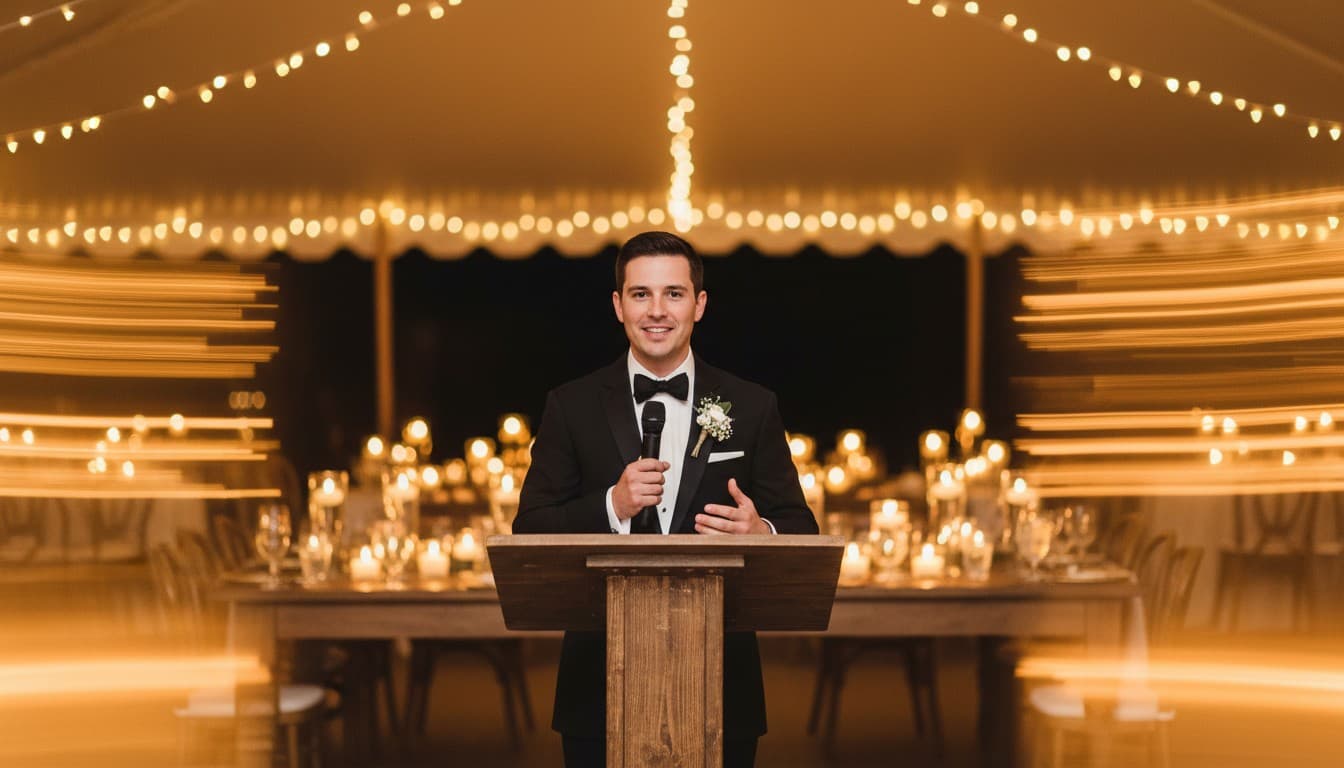
The first ten seconds of your wedding toast will determine whether the room leans in or drifts. Everything else, the stories, the jokes, the heartfelt ending, depends on whether you've earned the audience's attention in those first ten seconds.
This is the part most people skip. They write the middle first, the parts they already know they want to say. Then they slap something on the front and hope it works. It usually doesn't.
Here's how to actually nail the opening, and why it matters more than you think.
Why the opening is everything
Three things happen in the first moments of a speech that determine its entire arc.
The tone is set. If you open with a joke, you've told the room this is a comedy. If you open with vulnerability, you've told them something real is coming. You can adjust as you go, but reversing the initial impression takes real skill. Better to set the right tone immediately.
The room's attention is captured or lost. People at weddings have been at a wedding all day. They've eaten. They've had a few drinks. They're happy, but they're also distracted. You have one shot to make them put down their glasses and actually look at you. A generic opening lets that moment slip away.
Your nerves settle, or they don't. This is the one nobody talks about. A strong opening, one you've practiced and believe in, gives you something to hold onto. You know the first line works. That confidence carries you into the second sentence, and the third. A weak, uncertain opening leaves you stranded on the stage wondering how the next five minutes will go.
5 types of openings that work
1. The specific memory
Start with one moment. Not a summary of who this person is. Not "I've known him for ten years." One scene: a time, a place, something that happened.
"It was 2am on a Wednesday and she called me because she'd locked herself out of her apartment. Again. I drove over. I always drove over. And I remember sitting on her front steps waiting for the locksmith and thinking: this is exactly the kind of friendship I want for the rest of my life."
2. The observation
Something you've noticed about this person that no one else has put into words. Something specific enough that it could only apply to them.
"She has this thing she does when she's about to say something important. She pauses, just for half a second, like she's making sure the words are right before they come out. I've watched her do it for nine years. She's done it with me through every hard conversation we've ever had. She did it when she first told me about him."
3. The admission
Honest vulnerability about the task itself, or about yourself as the person delivering it. This works when it's genuine, not performative self-deprecation.
"I've been dreading this since he asked me, not because I don't know what to say, but because I know exactly what I want to say and I'm genuinely not sure I'm going to get through it without embarrassing both of us."
4. The compliment that goes somewhere
Not "she's the most generous person I know." A compliment so specific it becomes a story, or that turns into something unexpected.
"Marcus is the most prepared person I have ever met. He has a plan for everything. A backup plan for the plan. A contingency for the backup. The only thing he never had a plan for was her. And I think that's the most honest thing I can tell you about how he feels."
5. The unexpected
Something that isn't obviously where a wedding speech would begin. A confession, an unusual observation, a piece of information that makes the audience think: where is this going?
"I almost didn't come to the party where they met. I almost convinced her not to come either. For the last two years, she has not let me forget that."
5 openings to never use
"For those who don't know me..."
Everyone at a wedding knows who the key speakers are. And if someone genuinely doesn't know you, your name and relationship to the couple takes five seconds. Starting with "for those who don't know me" signals that you're nervous and filling time. Skip it entirely.
"Webster's dictionary defines marriage as..."
It has been used in approximately one million wedding speeches. It signals immediately that the speaker ran out of ideas. The dictionary definition of anything is not an opening. It's a stall.
"I'm not much of a speaker..."
If you say this, the room believes you before you've said anything worth evaluating. You've set the expectation floor at "not much." Anything short of brilliant will confirm the warning. Even if you are nervous, even if you have never given a speech before: don't announce it. Just speak.
"I'll keep this short."
You are now in a race against your own promise. Every sentence that follows will be measured against this commitment. If your speech is more than two minutes, which it will be, you've started with a lie. Worse, you've implied that the speech isn't worth taking time over.
Jokes that need explaining
If you catch yourself saying "okay, so for this to make sense, you need to know that back in college..." the joke is already dead. Great opening jokes are either immediately understood or immediately intriguing. Anything that requires setup before the setup is too complicated. Cut it.
6 example openings across speech types
These are fictional. They're here to show, not to be copied.
Best Man (the specific memory): "The night before his first date with her, he called me at 11pm to ask what he should wear. He never asks anyone what to wear. I knew it was serious."
Maid of Honor (the observation): "She talks about him the same way she talks about things she loves, like good books and her grandmother's cooking. Like they've always been there. Like she can't imagine what it was like before."
Father of the Bride (the admission): "I've been thinking about this speech for thirty years. I want you to know that it is significantly better in my head."
Groom (the unexpected): "I had a whole speech written. I scrapped it last night because I realized I was trying to sound like someone giving a wedding speech, instead of just being honest with the person I'm actually talking to. So here's honest."
Mother of the Bride (the compliment that goes somewhere): "She has her father's stubbornness and my inability to leave a room without making sure everyone is okay. I used to think those were separate qualities. Watching her with James, I've realized they're the same one."
Maid of Honor (the specific memory): "We became best friends during a three-hour train delay in February, somewhere between Leeds and London. She shared her snacks with a stranger, started a conversation with everyone in the carriage, and organized an impromptu card game. I thought: either this person is exhausting or I need to know her forever. It was both."
How to find your opening
The right opening for your speech is already inside you. You just have to excavate it.
Ask yourself these questions and write the first thing that comes to mind:
- What's the one story about this person that only I know?
- What's something I've noticed about them that I've never said out loud?
- What was the moment I first understood who they really were?
- What do I want them to remember that I said today, ten years from now?
That last question usually gives you your ending. But sometimes it gives you your opening too. The things you most want to say are almost always the right place to start.
Keep reading:
- A Short Wedding Toast That Lands Every Time
- Wedding Toast vs Wedding Speech: What's the Difference?
- How to End a Wedding Speech
Your opening line is the door. Everything else is the room behind it. Make it worth walking through.
SpokenVow interviews you the way a speechwriter would, asking exactly these kinds of questions to surface the opening only you could give. Then it builds the rest of the speech around it.