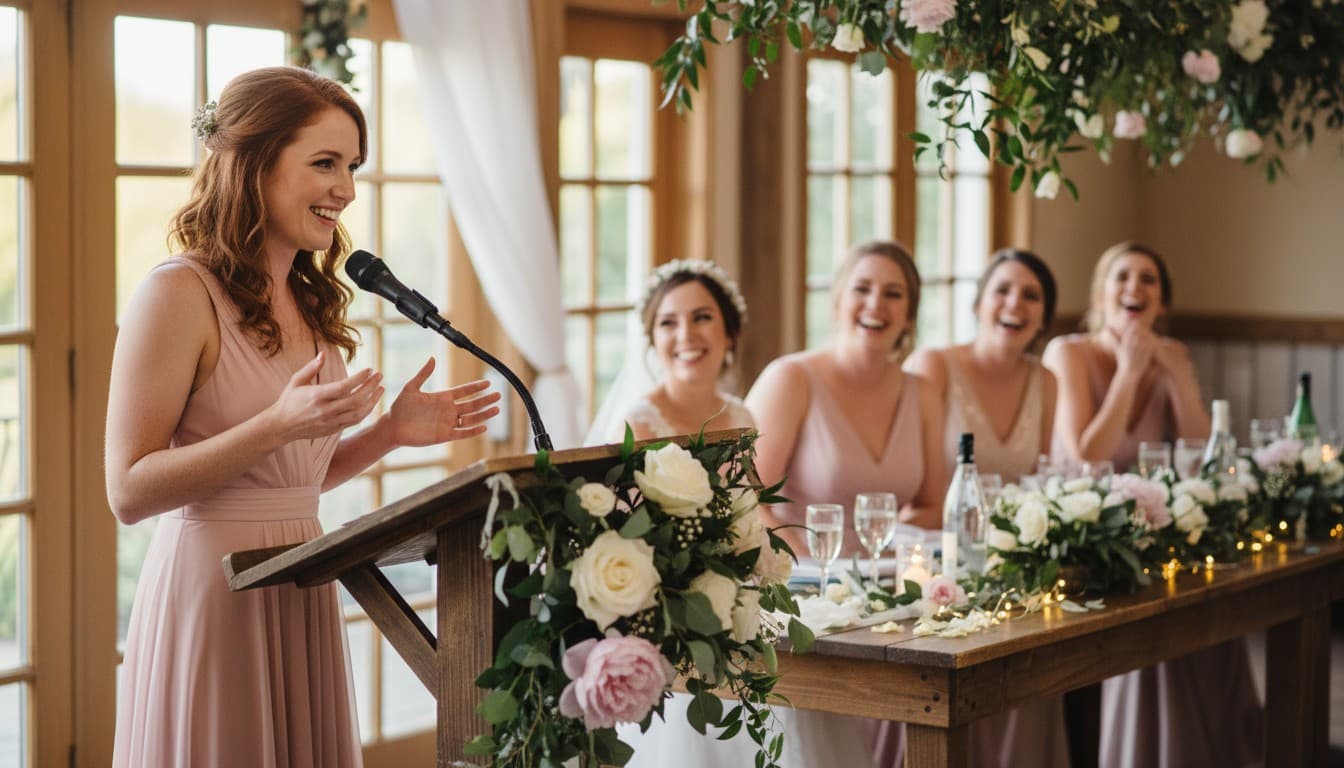
How to Write a Sister of the Bride Speech (With Examples)
A guide for sisters writing the maid of honor or wedding speech: what to say, how to structure it, what to avoid.
Related: Maid of Honor Speech Guide : the complete resource for anyone giving a speech for the bride.
Nobody in that room knows the bride the way you do. Not her college roommate, not her oldest friend, not even the person she's marrying. You grew up in the same house, shared the same parents, fought over the bathroom, and watched each other become who you are.
That history is the whole advantage of a sister speech. It's also the whole pressure of one.
What makes a sister speech different
Every great wedding speech is specific. But a sister speech has access to a kind of specificity nobody else can claim: the long view.
You knew her before she figured herself out. You watched her become. You have years of footage that nobody else was in the room for.
That's your material. Not the college stories or the bachelorette weekend, though those can show up too. The texture that only you can bring is the before version of her: the teenager, the kid, the girl who became the woman standing up there.
A best friend can say "I know her so well." You can say "I knew her when."
Use that.
The structure that works
You don't need a template. But most sister speeches that land well follow this arc:
An opening that doesn't start with "Hi, I'm [name]." You're her sister. Everyone in the room already knows that. Skip the credentials and start somewhere interesting.
Try opening with a scene, not an introduction. Something specific and small that immediately puts the room inside your shared world:
"When we were kids, she used to come into my room at 2am during thunderstorms. She'd say she was checking on me. She was terrified. I was never allowed to tell anyone."
That's an opening. It's warm, it reveals something true, and it sets a tone in ten seconds.
Two or three stories, not a highlight reel. The instinct is to cover everything. The trips, the fights, the hard years, the funny years. Resist it. Pick two or three moments that are genuinely illuminating, not just memorable. What do those stories show about who she is? That's the question.
The best stories don't need to be dramatic. Often the most revealing ones are quiet. The habit she has. The thing she always says. The way she handled something hard. Specific detail outperforms grand statements every time.
The turn toward her partner. At some point, shift from talking about her to talking about them. What did you notice when she started talking about this person? What changed in her? When did you know it was real?
Find a specific moment, not a general impression. "I knew when she started cooking again" is better than "I could just tell she was happy." The concrete detail carries the emotion.
A close that's actually an ending. Not a summary. Not a recap of everything you just said. Something direct, from somewhere deep, aimed right at her.
The toast is the period on the sentence. Keep it short. Say what you mean. Raise your glass.
What to avoid
Inside jokes that need subtitles. Every close relationship has them. Most of them don't travel. If you find yourself needing to explain the context before delivering the punchline, that's a sign the joke is for you, not the room. The stories that work best make outsiders feel like insiders, not the reverse.
The embarrassing story you're tempted to tell. You know the one. The thing she would actually prefer stayed between you. There's a version of it you could tell that feels playful, and a version that makes her sit there hoping it ends soon. If you're not certain which version you're telling, cut it.
A speech that's really about you. Easy to do without noticing. You start with a story about her, it transitions to how it made you feel, and suddenly the speech is a tour of your personal growth. Check your draft. Count the sentences where she's the subject versus sentences where you are.
References to exes or the person who came before. Even as a joke. Especially as a joke.
Anything that singles out a family tension the room can feel. Weddings are already complicated for families. This speech is not the place to process it.
Opening lines to adapt
These are structures, not scripts. Replace every specific detail with yours.
"Growing up, she was the one who [specific habit or behavior]. I used to [your reaction]. It took me twenty years to realize that was exactly what made her [genuine quality]."
"There's a story she's probably hoping I won't tell today. I'm going to tell a different one instead."
"I've had a lot of time to think about what to say today. The problem is I keep thinking about [specific memory], and once I'm in that memory, everything else feels small by comparison."
"She would not describe herself as [adjective]. Every person in this room would."
On length and nerves
Four to five minutes is the right window for a sister speech. Three and a half minutes, delivered with intention, is more than enough.
Time yourself out loud. Not in your head, where the timing is always wrong. You will almost certainly run long the first time. Cut until you don't.
You will probably cry. That's fine. The room will wait. A pause while you collect yourself is not a failure, it's evidence that you mean what you're saying. Keep going.
Keep reading:
- The Complete Maid of Honor Speech Guide
- Best Wedding Speech Opening Lines
- How to Not Cry During a Wedding Speech
You have decades of material. The hardest part isn't finding the stories. It's finding the right ones, and knowing how to shape them into something the room can feel.
Need help pulling it all together? SpokenVow interviews you the way a speechwriter would, drawing out the moments only you know, then builds drafts shaped around your voice and your sister.