The Groom Speech: What to Say, What to Skip, and How to Make It Count
A practical guide for grooms who need to stand up in front of everyone and say something worthy of the moment.
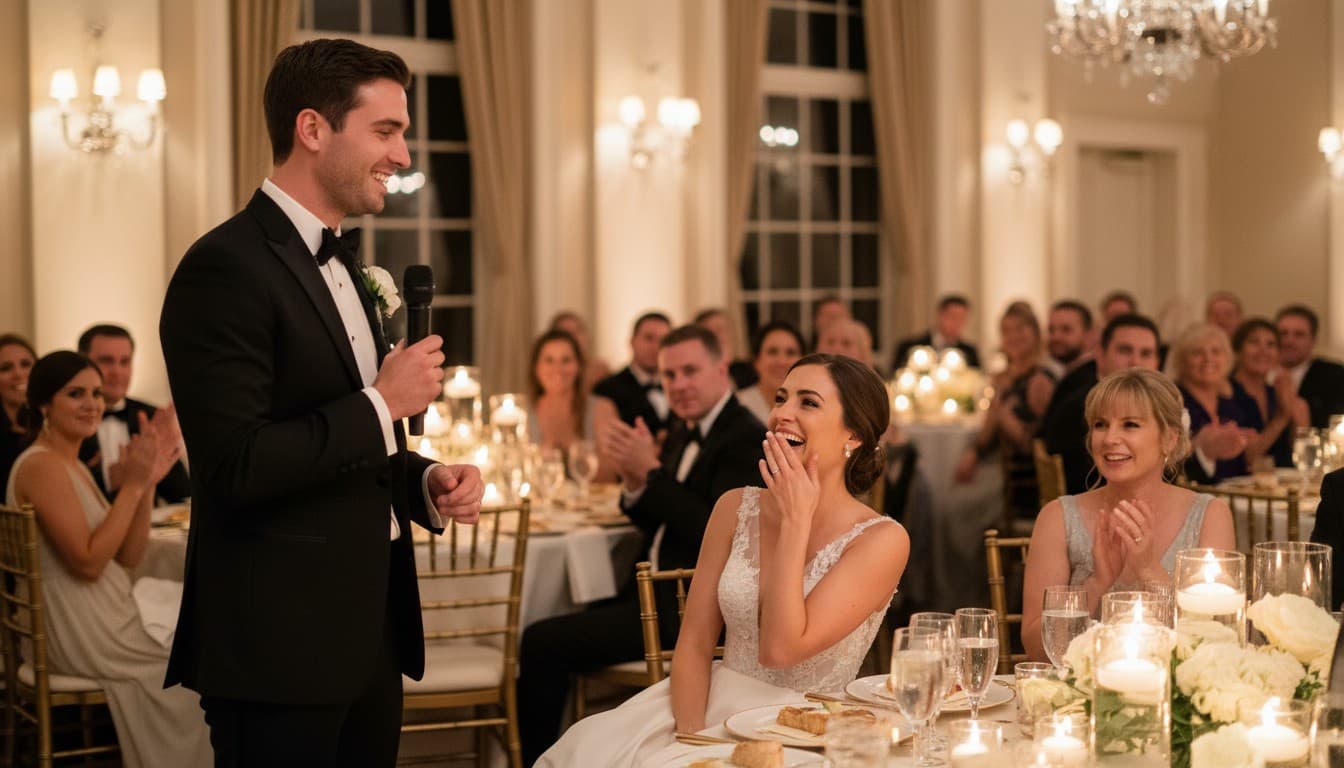
Part of the Groom Speech Guide : what to say, what to skip, and how to make it count.
Every other speaker at your wedding gets to talk about you. The best man roasts you. The maid of honor toasts your partner. The father of the bride gives a blessing. They're all performing for the room.
You're the only one who has to be genuinely, directly, publicly honest. With everyone you know watching. Including your new spouse, who knows when you're performing.
That's the pressure of the groom speech. It isn't just a speech. It's a public declaration that needs to feel private.
Here's how to write one worth giving.
The pressure that's actually on you
Unlike anyone else at the wedding, your job pulls in multiple directions at once.
You have to thank people, which is logistical and can easily turn into a list. You have to honor your wedding party, which is social and ceremonial. And you have to say something real to the person you just married, which is the only part that actually matters.
Most grooms get the order wrong. They spend the first four minutes on the list and the last thirty seconds on the person they married. The room remembers the last thirty seconds. Make sure those thirty seconds aren't rushed.
There's another pressure too: you know everyone. The best man can ignore the aunts he's never met. You cannot. The father of the bride can focus entirely on his daughter. You cannot. You're holding the whole room at once, which means you have to be more disciplined than anyone else about what you include.
The structure that works
Three movements. In this order.
First: Thank the families. Both sides. Specifically. Your parents and hers (or theirs). Not just "thank you to both our families" which means nothing to anyone. A specific sentence for each set of parents that says something true about what they gave you or what they mean to you. Thirty to forty seconds, maximum.
Second: Honor the wedding party. Not individually. In groups, by relationship. "My groomsmen, who have been a constant since we were nineteen, who showed up for the stag without complaining about where I picked" is better than "James, Tom, and Ravi, I just want to say how much..." The group acknowledgment feels warm. The individual name-check feels like roll call.
Third: Toast your partner. This is the main event. Everything before it is preamble. This section should be the longest, the most specific, and the most honest. It should feel like you wrote it for one person, not for an audience.
The order matters because it builds. You're moving from obligation to honor to love. When you arrive at your partner, the room has followed you there.
The most important part: what you say to your partner
This is the moment. Not the thank-yous. Not the jokes about the stag. This.
The grooms who get it right do one thing: they stop performing for the room and speak directly to their partner. You can look at them. You should look at them. The audience will feel what your partner feels in this moment, which is the point.
What to include:
One specific detail that only you would notice. Not "you're beautiful" or "you make me a better person." Something precise: the way they handle a hard day, the thing they do that you've never told them you love, the moment you first knew.
What changed in you. Not what they are. What you became because of them. This is harder to write and more powerful to hear.
What you're promising. Not the ceremonial vows again. Something practical, personal, true. The thing you will actually try to do every day.
Don't rush this section. Don't cut it to save time. The thank-yous can be trimmed. This part is where the speech lives.
How long to go
Two to three minutes. No more.
Grooms almost universally go too long, and the reason is almost always the same: they don't want to leave anyone out. They thank the families, the wedding party, the venue coordinator, the florist, the childhood friend who couldn't make it. Every addition feels necessary in the moment of writing it. From the audience's perspective, it starts to feel like a credits sequence.
Two things will help you trim:
Time yourself reading it aloud. Not in your head. Out loud, at actual speaking pace. Most people speak about 130 words per minute with natural pauses. Two minutes is roughly 260 words. Three minutes is 390. If you're at 700 words and climbing, you have work to do.
Ask yourself, for every sentence: is this for me, or is it for the room? Thanking someone because you genuinely can't give this speech without acknowledging them is for the room. Thanking someone because you're worried they'll notice if you don't is for you. Cut the second category.
How to thank people without it becoming a list
The list is the enemy of the groom speech. It turns a warm, personal moment into something that sounds like an awards acceptance speech.
Group by relationship, not by name. "My parents, who built everything I am and then handed me the tools and stepped back" lands better than "Mum, Dad, thank you for everything you've done." The former says something. The latter is filler.
Say one true specific thing per group. Not "thank you for all your support." What specifically did they do? What does it mean to you? One sentence that actually means something is worth more than a paragraph of generalities.
Let some people go unthanked in the speech itself. You will thank the caterers personally. You will thank your aunt later. The speech is not the place for a complete list of everyone who contributed. It is the place for the few people without whom the day, or your life, would be different.
The closer: your toast line
The last thing the room hears should be directed at your partner. Not a general toast. Not "please raise your glasses to the happy couple." A line that is for them.
This is your one chance to say something in front of everyone that is specifically, unmistakably for the person next to you. Make it count.
It doesn't have to be poetic. It has to be true. "To the person who makes me want to be worth it, every day" is better than a borrowed quote. "To the best decision I ever made on a night I almost stayed home" is specific to your story.
Raise your glass after. Let the line land first.
Keep reading:
- Groom Speech Examples
- 50 Wedding Speech Opening Lines That Actually Work
- How to Not Cry During a Wedding Speech
The groom speech is the one speech at the wedding that has to be both public and private at once. Getting that balance right is the whole task.
SpokenVow interviews you the way a speechwriter would, pulling out the specific details, the honest observations, the voice that's yours. Then it builds a complete draft around what only you could say.